Showing posts with label Italian Christmas. Show all posts

Thursday, December 22, 2011

An Italian Christmas for the Italians

Italians are patriotic when it comes to shopping. And this is never truer than at Christmas. According to a recent survey, Italians will spend 2.2 billion on ‘Made in Italy’ products over the festive holidays. They’re looking for value for money, eschewing anything that’s out-of-season (peaches and cherries etc), opting instead for home grown and local. A whopping 73% said that they would only buy products ‘made in Italy’, a level of patriotism which is much higher than the European average of 60%.

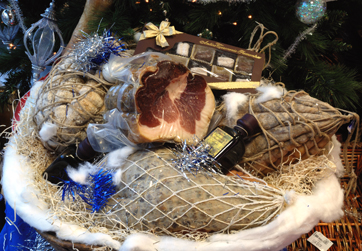
Most Italians intend to give food as gifts for Christmas. Among the top contenders are Christmas sweets, torrone [nougat] and chocolates, Tuscan panforte and cantucci biscuits, pandolce from Liguria, panettone, struffoli from Campania and Puglia and various salumi or cured meat products made throughout the country. Specialty pastas, lentils and beans also feature high on the national gift list. Of those surveyed, 33% intend to buy local and 28% organic.

The gift of food, for Italians, is considered the greatest gesture one can make. Over the summer, Italians fortunate enough to own a large vegetable garden will gladly pick a few extra tomatoes for their neighbour every time they venture into the garden for the ingredients for a salad. So too, an excess of mushrooms, truffles or any wild food gathered is almost always shared with friends and family. The gift of food is always appreciated and it never gets old.

Why? Because the appreciation of food in Italian culture still stems from a time when food was scarce. The hard times, or cucina povera of old, is still engrained in the national psyche. And it wasn’t so long ago. The older generation in Italy is still young enough to remember times when food wasn’t readily available – and it’s a lesson that’s passed from one generation to the next. The frugality of the times was such that festive occasions such as Christmas became heightened in importance. The weeks, even months, in the run up to Christmas was a time of sacrifice. Eggs would be stored to make pasta, chestnuts and mushrooms would be dried and a good salami would be hung specially for the occasion. These were not foodstuffs that were eaten on a regular basis. Any surplus would have been sold to buy sugar for something sweet on the day.

Of course, there’s another angle to the Italian appreciation of food as a gift. It’s one steeped in religious tradition. The Italian Christmas begins on Christmas Eve and carries through to the Epiphany on the 6th of January. Gifts of food given in the days before Christmas are intended to last throughout the festive season. They are not exclusively intended for Christmas day. Again, this in part reflects a culture that left nothing to waste and understood the importance of making things last. It’s no coincidence that many dishes made over the festive season are dishes that are made to last – panforte, tortelli, panettone, spongata, the various cured meat products, to name just a few – and will be enjoyed throughout the two weeks of Christmas.

Christmas in Italy is very different from Christmas in most other countries I’ve spent time in. Although modernity has taken its toll, with an element of commercialism creeping in, it certainly hasn’t changed the fundamental character of the festive season. Personally I’m not complaining. There’s something quite comforting about going back to basics. These days I’ve come to expect the inevitable knock on the door followed by a panettone and a bottle of something homemade. I’m guilty myself – this year I have a surplus of dried mushrooms packed into pretty jars, homemade apricot and cherry jams, as well as some great biscuits. It beats socks and soap any day of the week!  

Saturday, December 17, 2011

Dolce Natale - Sweet Christmas

With Christmas just around the corner, it’s time to get serious about the menu. And a good place to start is with desserts. For most of the year Italians buy or eat their desserts at the pastry shop or in the café. Christmas is one of the exceptions to the rule. Luckily, however, as most Italian Christmas cakes keep well they can be made in advance taking at least some of the stress out of the day! Here’s two recipes you might like to try that are very popular and quick and simple to make. Incidentally, both recipes also make great gifts!


Pampepato
Ferrara’s famous cake, the pampetato, was first mentioned in a document dating back to 1465. It is believed that the original recipe was created by the famous renaissance chef, Cristoforo da Messisbugo as a tribute to the Pope. It was, at the time, known as Pan del Papa (Bread of the Pope). Over time the name changed but the essence of the cake has remained the same.

Despite its name, pampetato is not ‘peppered’ or ‘spicy’, unlike many of Italy’s Christmas desserts.  It is, however, a rich fruit and nut-based cake covered in chocolate and in its final form has been likened to a small pumpkin. It is still very much associated with the city of Ferrara and over the Christmas period bakery windows are filled with wonderful displays of their favourite cake. 


Pampepato
Spiced chocolate cake

Serves 6-8
Preparation time: 10 minutes
Cooking time: 20 minutes

200g plain flour
100g blanched almonds
100g caster sugar
80g plain cocoa powder
100g candied fruit
Teaspoon ground cinnamon
2 finely ground cloves
120-150ml warm milk
100g plain chocolate

Place the flour in a large bowl and add all the other ingredients with the exception of the chocolate and the milk.  Stir together well.  When all the ingredients are well combined, add 100ml of warm milk and stir in.  Continue adding the milk a little at a time until a soft but firm dough is formed.  Work the dough a little with your hands to form a ball and then shape into a dome.  Place this on a baking sheet and bake in a preheated oven at 170ºC for 20 minutes.  Once cooked, remove from the oven and cool on a wire rack.  When completely cool, melt the plain chocolate in a double boiler and then drizzle all over the pampepato.  Allow the chocolate coating to set before serving.  This cake is very rich and dense, so it should be served in small slices!


Salame di cioccolato
The chocolate salami is something of a newcomer. It’s not strictly traditional but a more modern day invention. It’s still considered something of a novelty in Italian homes, especially for children, and its relative simplicity in the making, and the fact that it can be made well in advance and keeps well, has made it an increasingly popular dessert. It is eaten of course sliced, just like a salami, albeit not at the start of a meal! It is generally enjoyed along with coffee and liqueurs.


Salame di cioccolato
Chocolate salami

Serves 12
Preparation time: 10-15 minutes + chilling
Cooking time: N/A

150 – 180g dry biscuits
130g unsalted butter
100g caster sugar
75g plain cocoa powder
50g blanched almonds
2 egg yolks
1 shot of rum

Place the egg yolks and half the sugar in a large bowl and whisk with an electric beater until light and foamy.  Next, add the butter which has been melted and cooled, the cocoa powder, the rum and the rest of the sugar.  Beat again to mix everything together.  Finally, add the biscuits which have been roughly crushed and the almonds.  Stir together well.

Place a large sheet of greaseproof paper on the work surface and tip the mixture out onto the paper in the shape of a salami.  Fold the paper over the mixture and press down, compacting the mixture and at the same time trying to create an authentic salami shape.  When you’re happy with the final result, wrap the ends up well and place in the fridge for at least 3 hours before serving.  Before serving, if you roll the salami in icing sugar it really lends to an authentic salami look.