Tuesday, January 31, 2012

A Cassata in a van

Lillo the Sicilian makes his living from driving a van filled with local produce from his home town just outside Palermo to the north of Italy. He makes the 1,300 km journey at least twice a month. In the winter the van is packed with crates of fresh oranges, mandarins and large, knobbly lemons, as well as bottles of extra virgin olive oil. He spends a couple of days parked by the roadside just down the street from my house, in the freezing cold, selling the fruit by the crate. Lillo’s always smiling and there’s always a brisk trade around his van. His fruit is of the highest quality – and everyone takes the opportunity to make their year’s supply of limoncello.

A few years back, on a particularly cold day, I took him a flask of pastina (little pasta) in chicken broth and a bottle of wine. We’ve been friends ever since and today, when he comes, he always brings a little something extra for me in his van. A couple of month’s back it was a large tub of olives, before that wine from his own vineyard. This time his wife made me a cassata – ‘it’s for the children’, he warned.

Cassata Siciliana is a sweet from Palermo in Sicily. It was traditionally made and eaten over Easter but today it can be found in bakeries all year round. There are mixed views on when or how it originated. Some claim that its roots lie in the Muslim Middle Ages, the name deriving from the Arabic word qas’at, meaning the large kettle or container which was used as a mould for the cake.  This theory is disputed as some food historians believe the name originates from the Latin word for cheese, caseus, possibly making it a dish of Roman origin. It could be that there is truth in both theories as the ingredients point to influences from both directions.
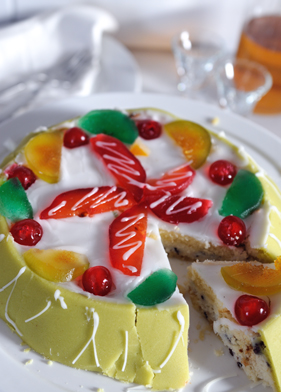
It’s a moot point. Lillo’s wife’s cassata was everything a good cassata should be – colourful bordering on garish on the outside and very sweet, slightly alcoholic, fresh and creamy on the inside. The interior of the cake is made with an unctuous mixture of creamed ricotta, sugar, sponge, liqueur, candied fruit and chocolate chips. The sides are lined with a further layer of sponge and then encased in a layer of green marzipan. Traditionally the case would have been made with an almond paste, an idea which was claimed to have originated in the convent of Martorana in Sicily. However, today it’s prohibitively expensive to make cassata in this way and so a simple coloured marzipan is used instead.  The top of the cake is then decorated elaborately with crystallised wedges of candied fruit – oranges, pears, lemon wedges and cherries – and, traditionally, zuccata (pieces of candied pumpkin).  

It’s not a cake I’ve ever tried making myself. It’s laborious and elaborate work and just decorating the top is an art form in itself. What’s more, in my excitement last night, I completely forgot to ask Lillo if he could give me his wife’s recipe. I’m going to go and see him this afternoon. There’s a sbrislona baking in the oven as my wife wants to return the favour. As soon as I get the recipe I’m going to give it a try and I’ll get back to you!

Friday, January 27, 2012

Deep Fried!

My good friend Sandro Rizzi shares a sarcastic sense of humour – something of a rarity in Italian society. In the heat of a good-spirited debate he resorts to calling me names. Usually it’s something along the lines ‘un povero mangiatore di pesce fritto e bevitore di Guiness’ [roughly translated, a poor fried fish eater and drinker of Guinness]. As far as Guinness is concerned, what can I say, I’m part Irish. As for the former, again I raise my hands: I have a liking for deep fried fish in batter – hardly surprising, given my parents were in the deep-fried-fish business back in Belfast.

Italians don’t like to admit it, but they too have a proclivity for deep-fried. You only have to look at the displays in bakeries and cake shops in the run up to Carnival. The mountainous trays of fried pastries are hard to miss. It’s a national preoccupation, the only thing that changes are the names – among others, chiacchiare (gossips) in Milan, crostoli in Alto Adige, bugie (lies) in Piedmont and lattughe (lettuces) in parts of Emila Romagna. Alongside these delicate flat pastries, frittelle (small deep-fried dough balls) - some stuffed with cream, others simply sprinkled with sugar – are practically ubiquitous throughout the country. And these are just a couple of the more common deep-fried treats, made and sold throughout the country this time of the year. To list all the regional variations would have me blogging into the next week!

As it happens, it’s not just deep-fried pastries that Italians are partial to. Nor is the deep-fryer reserved for those few weeks in the run up to Lent. Think about the popularity of fritto misto, a dish made and served in restaurants all along Italy’s 7,500 km’s of coastline and I begin to suspect I’m not the only mangiatore di pesce fritto in town.

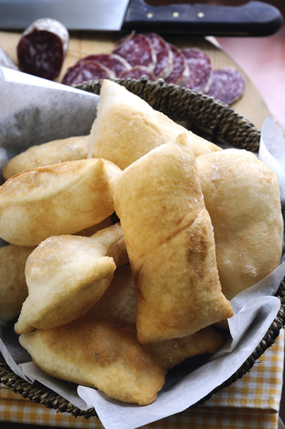
I’m in the minority of Italians that doesn’t happen to live along the coast. But that doesn’t mean we don’t get our fair share of deep-fried. On the contrary, in the absence of an abundant supply of fresh seafood, we deep-fry our dough! It’s a specialty most commonly known as gnocco fritto. In Bologna, where it’s said to have originated, it also goes by the name crescentina. In Parma it’s called torta fritta and here in Piacenza it goes by the name of chisolini [or chisulén in the local dialect]. Needless to say these deep fried balls of dough go by many names. They are most often eaten over the summer months, being sold at practically every festival. However, restaurants in Emilia also serve them and so they have become a year-round deep-fried treat (or habit, if you like). Their popularity stretches beyond regional boundaries. I’ve lost count of the times a car has pulled up alongside me as I walked my son home from school only to be asked by the hungry out-of-town occupants (usually from Milan) as to the whereabouts of the nearest restaurant that serves gnocco fritto over lunch [many of the local restaurants only switch their fryers on in the evenings over the weekend].    

How they are eaten depends on where in the country you happen to be. At festivals they tend to be eaten straight out of a paper bag with just a sprinkling of salt. In restaurants they usually come as an antipasto along with a plate of mixed cured meats. In certain parts of the country they are filled with ham and soft cheese.  Personally I could eat them any way. But the best way, in my opinion, is as they do here in Piacenza – served in a basket alongside a platter of thick cut slices of local salami.


Deep fried dough
Gnocco fritto

Serves 4
Preparation time: 15 minutes + resting time
Cooking time: 5 minutes

300g strong plain flour
150-180ml tepid water
½ teaspoon salt
10g fresh yeast
Extra flour for dusting
Lard or oil for deep frying

To make the dough, place the flour on a work surface and mix in the salt. Make a well in the centre and crumble in the fresh yeast.  Next add the water and knead together for at least 5 minutes.  Cover the dough with a clean tea towel and let rise for 1 hour, or until doubled in size.  After the dough has risen, knock it down and knead again for a minute or two before dividing into about 16 pieces.

Heat the oil or lard (traditionally they are made with the latter) in a deep-sided frying pan. Roll each piece of dough into a round about ½ - 1cm in height.  Carefully place the dough, in batches, into the hot oil and fry for 2-3 minutes, turning half way through, until golden and puffed up (like little bellies).  Carefully remove the fried dough with a slotted spoon, drain and sprinkle with salt. Serve hot with slices of salami.

Monday, January 23, 2012

Taboo? Italians and horsemeat

I was invited by a friend to eat horsemeat over the weekend. Although the idea arouses distaste and criticism for many in English-speaking countries, eating horse in many parts of Europe is still considered acceptable. The Italians, along with the French, the Belgians, the Dutch, the Germans, the Swedish, amongst others, to varying degrees, are all still ready consumers of horsemeat. The Italians have the highest consumption rates in Europe, although the tradition is concentrated in certain parts of the country - particularly in the Veneto, parts of Emila and Tuscany, Piedmont and parts of Puglia.

In Italy horsemeat is sold in specialist butcher shops. Ordinary butchers are prohibited from selling horsemeat. The meat itself is similar to beef, although many say it is slightly sweeter in taste and has a less complex flavour. That said, many Italians argue that it is a healthier option than beef, being both lower in calories and has a higher content of glycogen. Generally it can be treated in much the same way as beef. It also lends itself to curing (such as in bresaola and salami) and to eating raw. One of the most popular methods in Italy is a dish of steak tartare.

Horsemeat is something that most Italians will eat al momento. It does not keep as well as beef and therefore is best bought and used fresh on the day. Gigi had been nagging me for some time to try horsemeat with him. When I arrived he was busy preparing two plates. There are various recipes for preparing the dish but the principle is generally the same. A combination of lemon juice, garlic and chopped parsley is added to freshly minced meat. After a good seasoning the mix is allowed to rest for 5 to 10 minutes – during which time the lemon juice begins to cook the meat, explained Gigi. He also added a couple of small yet fiery chilli peppers – a personal preference.

There is little consensus when it comes to eating horsemeat. The tradition of doing so has existed in much of Europe for centuries. Although consumption rates have dwindled in the past years, it’s not a tradition that is going to disappear. I can understand the aversion that many people have to eating horsemeat. Yet, at the same time, in many parts of Europe eating horsemeat is deemed socially acceptable. I have to respect both viewpoints. It is the same dilemma that pervades over hunting. After ten minutes, Gigi gave the dish a final drizzle of extra virgin olive oil and pushed a plate in my direction. Now I had a decision to make – to eat or go home?            

Steak tartare

Serves 2 people
Preparation time: 15 minutes
Cooking time: N/A

400gms lean horsemeat (or beef), minced
1 lemon
2 cloves garlic, finely chopped
A handful fresh parsley, chopped
Nutmeg
1 small chilli, chopped
Extra virgin olive oil
Salt and freshly ground black pepper

Whether you are using horsemeat or beef buy it fresh from a reputable butcher. It is probably best that you mention that it will be eaten raw. Choose a lean cut of meat such as rump. Have the butcher trim off any excess fat and mince the beef. Place the meat into a bowl. Squeeze over the lemon juice and add the chopped parsley, garlic, chilli (optional) and a grating of nutmeg. Mix the ingredients very well and divide equally onto two plates. Flatten the mince down with the back of a fork and season with salt and freshly ground black pepper. Allow to rest for about 10 minutes. To finish, add a good drizzle of olive oil and serve with crusty bread and a simple salad.

Friday, January 20, 2012

Tagliatelle alla bolognese

 
Ragù alla bolognese is traditionally served with fresh egg tagliatelle (not, as some would have it, spaghetti)! The secret to a good ragù alla bolognese is ‘time’. This is not one for a quick evening meal, best you leave it for a leisurely Sunday lunch. It’s a substantial plate so you need only follow with a simple green salad and perhaps a platter of cheese.

The recipe uses milk in the cooking, which some might find a little odd. But the end, in this case, justifies the means. One word of warning; the aroma as it cooks will test your patience. You have to be firm. Open a bottle of wine, slice some salami and prosciutto and wait it out. The result, in my view, is without a doubt one of Italy’s greatest culinary achievements. But what would you expect coming from a city nicknamed ‘the Fat’!

Serves: 4
Cooking and preparation time: approx 2.5 hours

Ingredients
300g beef mince
150g pancetta
50g carrot
50g celery
30g onion
5 tablespoons of tomato passata
½ glass of dry white wine
1 glass of full fat milk
Salt and freshly ground black pepper

Method
Finely chop the pancetta with a half-moon chopping knife and place it into a heavy-based (terracotta, if you have it) frying pan.  Over a very gentle heat allow the fat from the pancetta to melt. 
While you are waiting, finely chop the carrot, celery and onions. When the fat has melted add the vegetables to the pan and allow to soften.  Next add the beef mince and fry until it begins to colour (but not brown).  Finally, add the wine and tomato sauce, stir and leave it to simmer on a gentle heat for approximately two hours. 

At this point you might want to think about opening that bottle of wine. But whatever you do, don’t forget about the sauce and let it dry out. Check every 20 minutes and as it begins to dry, stir in a little of the milk. You should get through a good glass full. Finally check for seasoning.

Serve the sauce over fresh egg tagliatelle (about 80gms per person). You can buy this at the supermarket or, alternatively, for a real treat make it yourself while you are waiting for the sauce to cook. It’s worth it!

Thursday, January 19, 2012

Gastronomy, place and preserving traditions

 
On the 17th of October 1982 Bologna’s Chamber of Commerce agreed and recorded the official recipe for Ragù alla Bolognese. It marked the end of a long process which was initiated in the 1970s by the City Council and l’Accademia Italiana della Cucina di Bologna to bring about a modicum of official clarity to what is regarded as one the world’s most popular dishes (although, strictly speaking it’s not a dish, rather a sauce).

It’s not the only Italian dish that has been officially registered. Costoletta alla Milanese was given Denominazione Comunal (De.Co.) status on the 17th February 2008.  Risotto alla Milanese was granted its badge of authenticity as a typical Milanese plate in 2007. The list is long and includes such household names as bistecca alla Fiorentina, pesto Genovese and even traditional Neapolitan pizza.

Registering a dish that stems from a city or the surrounding territory is not simply a question of laying claim to ownership. Certainly that’s part of it. But more than that, it’s a question of cultural heritage. In Italy food is an expression of cultural heritage. Gastronomy and place are synonymous - it’s what sets one region apart from another.  Just as such great architectural landmarks as the Coliseum, Piazza San Marco or the Ponte Vecchio conjure images of historical cities such as Rome, Venice and Florence, so too do its great dishes. Risotto alla Milanese and Costoletta alla Milanese are as much a part of Milan’s cultural and historical heritage as the magnificent Duomo or the Galleria.

Earlier this week Italians across the globe celebrated their culinary heritage with the 5th edition of International Day of Italian Cuisine. The rationale behind the event, at least in part, is to promote and help preserve the authenticity of Italy’s traditional dishes. It’s a worthy cause. The dishes selected each year to mark the event are those most recognized throughout the world – they also happen to be the most imitated, misunderstood and often abused. Anyone who as ever sat down to a plate of spaghetti and boulder-sized meatballs or spaghetti drenched in a meat ragù, often erroneously labeled spaghetti Bolognese – or worse still, ‘Spag Bol’ – should at least appreciate it has nothing to do with the fair city of Bologna.

‘Isn’t this a lot of fuss over a name’, you might well ask? It’s like this: if I happen to be in Milan doing some shopping I can go to practically any restaurant, order a plate of risotto alla milanese or osso buco alla milanese or costoletta alla milanese and know exactly what I’m going to get. Similarly, if I happen to be working down south somewhere, in the heat of the summer, I can order an insalata caprese and I know that the light refreshing plate that will follow won’t have me struggling back to the hotel for a siesta. The Italian menu is, in effect, a road map – one that’s easy to navigate (once you know how to read it) and it keeps you on track.

Over the past years Bologna, like other cities across Italy, has felt compelled to put an official stamp on their culinary heritage. It’s about more than just protecting or laying claim to a name as nnyone who has ever been to a restaurant and ordered an old friend, only to be confronted with an impostor, will understand. And don’t get me wrong: I have nothing against meatballs… or spaghetti for that matter. Just call it what it is and keep Bologna out of the equation!

Monday, January 16, 2012

International Day of Italian Cuisine, Saint Antonio Abate and osso buco

Tomorrow marks the 5th edition of International Day of Italian Cuisine. For the past 5 years the 17th of January has been set aside to celebrate the Italian contribution to world cuisine. Every year a classic dish from the pantheon of Italy’s great and good is selected to mark the occasion. This year it’s osso buco alla Milanese

Unlike many of Italy’s classic dishes, relatively little is known about the origins of osso buco – or oss buss [pronounced oss buse] in the local Milanese dialect. Milan’s city council registered the dish in 2007 as a De.Co., which effectively means that the dish stems from the local territory. As to when it first made an appearance, no one can really say. It certainly dates back some time as the recipe was included in Pellegrino Artusi’s famous book, ‘La scienza in cucina e l’arte di mangier bene in 1891. But whether it originated from cucina povera or higher end Italian cuisine is uncertain. The use of a cheaper cut of meat in the dish, veal shin, might suggest that it was a dish of the poor reserved, of course, for Sundays and special occasions, but not necessarily so.   

As for the dish itself, it is relatively simple to make, albeit somewhat time consuming. Veal shin, roughly 3cm in thickness, cut through the bone with the marrow included is lightly floured and browned in butter with onions. White wine or broth is added and the meat is allowed to simmer until meltingly tender – about 2 hours. The dish is finished with a gremolata of chopped parsley, lemon peel and garlic (and sometimes anchovies) and served traditionally with a risotto alla Milanese. Today, many people find the rice too heavy and opt instead to serve the veal over creamy mashed potatoes, polenta, plain white rice cooked in butter or just with rustic pieces of country bread. It’s a question of taste.

Other takes on the Milanese version include osso buco alla Fiorentina, a classic Sunday plate of the Tuscan kitchen. The method is pretty much the same except that a classic battuto of chopped vegetables (including celery, carrot and onion) is added and the meat is cooked in a tomato sauce. In Reggio Emilia a version known as alla reggiana is made in which the shins are cooked in a combination of white wine and tomatoes.

Now in its 5th year, International Day of Italian Cuisine has celebrated some of Italy’s most iconic plates. Previous contenders have included spaghetti carbonara, risotto alla Milanese, pesto alla Genovese and tagliatelle al ragù alla Bolognese. The event, in part at least, is intended to help preserve the identity of Italy’s classic dishes. The dishes selected are not only some of the country’s most widely known on an international level, but they are also some of the dishes that are most abused and misunderstood outside their country of origin.

It has to be said, however, that although International Day of Italian Cuisine has in a few short years achieved something of an international platform, it is still an event that in Italy goes by relatively unnoticed. Most Italians are ignorant of the newfound relevance of the 17th of January, many knowing it better as the Catholic feast day of Saint Antonio Abate, patron saint of, amongst other things, domestic animals, pigs, pig herders, butchers, salami makers, people with eczema and any other communicable skin diseases. For a nation that enjoys its salami more than most, that makes Saint Tony something of a VIP in Italian eyes.   

Unfortunately this year, I have to admit, I’m not going to be taking part in the celebrations, however unpatriotic that might sound. The truth is I ate osso buco alla Fiorentina in the mountains on Sunday with the family. We worked our way through over 1 kilo of veal shin! Fortunately, or not – depending on how you look at it - neither my wife nor my children indulge in the best part of the dish – the sought-after bone marrow. So I got to suck my way through the better part of a plate of bones (I used the suction method as I haven’t got around to buying a set of long handled spoons known as esattore, namely tax collector, which are designed for this very purpose). Eating through a kilo’s worth of bone marrow isn’t necessarily a good idea. But I couldn’t help myself. As expected, chronic indigestion followed yesterday evening. Luckily I had a bottle of nocino [an excellent digestive] to hand to ease my suffering. Tomorrow I’m expecting to break out in spots. But I’m not worried. It is after all the feast day of Saint Antonio and he’s just the guy for taking care of that sort of thing!

Braised veal shanks, Florentine-style
Osso buco alla Fiorentina

Serves 4
Preparation time: 10 minutes
Cooking time: 2-2.5 hours
4 veal shank steaks
1 onion
1 carrot
A few celery stalks
1 clove of garlic
750ml tomato passata
200ml water
3-4 tablespoons plain flour
Olive oil
Freshly chopped parsley
Salt & pepper

Finely dice the onion, carrot and celery stalks.  Add a few tablespoons of olive oil to a large heavy-based frying pan and gently fry the vegetables and garlic until beginning to soften. This should take about 5 minutes.  Remove the vegetables from pan with a slotted spoon and set aside.  Lightly coat the veal steaks in seasoned flour and then place them in the same pan.  Add another tablespoon of olive oil and cook over a medium to high heat until browned on each side.  Return the vegetables to the pan and add the tomato passata and water.  Season with salt and pepper and simmer gently for 2 hours until the meat is soft and tender.  Sprinkle over freshly chopped parsley and serve over either mashed potatoes, polenta or rice.

Friday, January 13, 2012

Practice makes perfect in the kitchen

 
I took the family to the local pizzeria last night. The pizzaiolo, who’s become a good friend over the years, set my sons to work. For the past few months they’ve been learning how to make their own pizza - little pizza chefs in training you might say. My younger son, Giuliano, always opts for the classic margeherita. The older one, Massimo, likes to throw a little Italian sausage on top. It’s surprising how quickly, with a little perseverance and the occasional guiding hand, they’ve come to master the important art of pizza making. They now always make their own and last night, to my surprise, between the two of them they even managed to serve me up one of my own personal favourites – a pizza with extra onions, extra anchovies and olives. My wife wasn’t too pleased but the pizza was perfect! That’s practice for you.

A few days back I was watching TV and something I heard struck a chord. A celebrity chef was working his way through a recipe setting out a few key pointers in the making of a good stew.  The dish complete he said something along the lines that if you follow these principles ‘you never have to have the same stew twice’. In truth I can’t argue with that, there are no doubt endless versions on the theme. Similarly, in a cookbook I was reading some time ago, the author (a noted chef), pointed out that there is no reason ever to have the same bowl of pasta twice. Again, strictly speaking, I guess he’s right – if you consider the sheer number of commercially available pasta’s available these days, not to mention fresh pasta, coupled with infinite choice when it comes to dressing your pasta, you could theoretically go through life never having to eat the same bowl of pasta twice. I guess both chefs come from the ‘variety is the spice of life’ school of thought.

There is, of course, something to be said for variety. There’s nothing like a little experimentation in the kitchen to get the creative juices flowing. But then again, there’s also something to be said for revisiting a dish that’s been tried-and-tested. Here in the provinces my neighbours are true creatures of habit. They like to revisit the same old dishes time and time again. In fact, I would bet every single Euro in my wallet (which, trust me, isn’t many) that I could guess at least one dish that every one I have met and spoken with today has eaten in the past week. There’s nothing boring in that. In fact, it’s something that I (and my local neighbours) find reassuring. I still can’t bring myself not to eat fish on a Friday night – a habit I acquired as a child back in Belfast living above the family restaurant. I need a humble bowl of spaghetti red sauce at least twice a week or I start suffering withdrawal symptoms and Sunday lunch here just wouldn’t feel complete unless I started with a bowl of stuffed fresh egg pasta swimming in a sea of homemade broth.

As with the table, the same principle applies in the kitchen. If we are constantly changing what we eat, how are we ever going to achieve anything in the region of perfection? Let’s not forget that the same chefs who advocate a different dish every time we take to the kitchen probably cook the same dish dozens of times every day of the week at work. That’s why their food tastes so good - practice makes perfect!

Writing a short article on cucina della nonna for Taste Italia magazine a couple of days ago I got to thinking about the time I spent years back as my grandmother’s de facto apprentice in the kitchen. Like most Italian grandmothers, she was a creature of habit. She had her repertoire of recipes and she cooked them perfectly. Why she did so was simply because she had been cooking them all her life. And there was something wonderfully reassuring about knowing what to expect every time I visited. Those skills and flavours have carried with me and I’ve spent years trying to recreate her food to the point where I can’t tell the difference if my grandmother herself had been standing in the kitchen cooking – and, I still have some way to go!

I read somewhere once that to get really good at something – a trade, a skill, whatever – requires something in the region of 10,000 hours of practice. It’s a principle, I think, that applies well to the kitchen. You could, certainly, go through life never cooking or eating the same dish twice. But if you do so, how are you ever going to know what that dish could taste like? How are you ever going to become accomplished at making something? How would my sons ever have been able to make me my favourite pizza? Variety might be the spice of life in the kitchen - but practice makes perfect. No doubt the next time I have a hankering for a bowl of pasta or a warming pot of stew, I might well open a recipe book and try something new. But then again, I might just stick to an old favourite!