Thursday, November 24, 2011

Polenta and wild boar

Italians can’t help themselves; they are slaves to their cravings. With an hour’s notice I once travelled 200kms to the coast because a friend was suddenly stricken with an uncontrollable craving for fresh seafood. Another time I spent three hours in the car because someone decided it would be a good idea to get a steak in a restaurant just outside Florence. Another friend even suggested we take a train to Naples because he fancied a pizza – luckily work commitments put an end to that particular excursion.

A few days back someone suggested a trip to the mountains for polenta and wild boar stew. I should have seen that one coming. We are in the midst of wild boar hunting season here at the moment and Italian cravings tend to be seasonally dictated. From late autumn through to the end of winter everyone here is always talking wild boar and looking to get their fix. ‘Eat it while it’s in season’ - that’s what they say here.

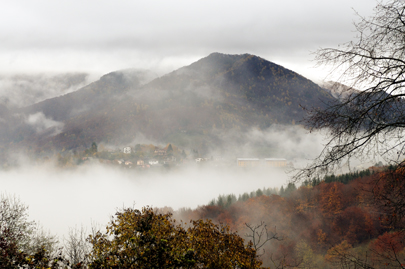
So that’s how I ended up driving in convoy to an off-the-beaten trattoria in the pre-Alps in Lombardy. We took three cars – wild boar has always been a popular choice here. It was a typical Alpine trattoria: rustic, hearty seasonal fare, a roaring fire, a warm welcome and a wonderful atmosphere. The polenta was local – a variety known as Taragna, a blend of coarse ground corn flour and buckwheat which takes about 45 minutes to cook. The stew was rich and moreish. Large chunks of wild boar cooked for hours in wine to the point where the meat simply fell off the bone. It might well have been a long drive but no one was complaining. Here’s to seasonal cravings!

Sunday, November 20, 2011

Cheese with [out] borders: Part 3

I’ve been returning all week to the subject of parmesan and I realise I’ve hardly begun to grate below the surface. Why I do so is this. Just as it’s hard to imagine a Chinese kitchen without a wok, so too the Italian store cupboard would seem bare without a piece of grana. It’s fundamental. To the Italian cook, a piece of grana is not simply a piece of cheese. Nor is it simply just another ingredient. It’s a kitchen utensil, indispensable in lending shape and character to everything from a simple bowl of pasta to a stuffing for a roast.

The famous gastronome, Massimo Alberini, put it much better than I ever could. He said: “[Grana] is without doubt, the most typical Italian cheese, not only for its intrinsic value but, more important, for the contribution which it makes to the flavour and nutritive value of many dishes, from minestrone to pasta, from polenta to certain vegetables. It enriches without suffocating, gives vigour without overwhelming, and, in particular, confers an Italian character to [each such dish]”. Whilst pasta has given substance to the cuisine of a nation, you could say, grana has stamped that cuisine with its own distinct identity.

Fundamental is not a word that should ever be used lightly. Yet one out of every ten items that pass through a supermarket checkout in Italy is grana. Whether it’s Parmigiano Reggiano, Grana Piacentino or some other grana is beside the point. It’s simply that fundamental. As I’m standing on the bridge, the border between two great cheese producing zones, I understand how ancient provincial rivalries can endure through cheese. In Italy, grana is more than just a condiment that you grate over a steaming bowl of spaghetti. It’s a cornerstone of the Italian kitchen. It’s a 1,000 year’s of tradition. It’s part of the culinary character and DNA of a nation. It’s fundamental.

Thursday, November 17, 2011

Cheese with [out] borders: Part 2

Both the people of Parma and Piacenza claim that their grana – cheese – was the original one.  Neither claim has been proven. What is clear is that the history of grana can be traced back at least as far as AD1000. It coincided with a time when monks in the Po Valley created a system of irrigation thereby enabling intensive dairy farming and the production on a large scale of milk for cheese.

Methods of production haven’t changed much in the intervening centuries. The process stems from a method which dates back, some food historians argue, to the time of the Etruscans. A combination of science, artisan intuition and nature all play their part. The milk comes from morning and evening milking, partially skimmed of cream. Natural whey ferments are added and the milk is heated. Rennet is added and coagulation takes place. The curds are then broken manually using a spino – a long, over-sized balloon whisk - and reheated until the right consistency is achieved. They are then allowed to sink into a mass at the bottom of the vat before being manipulated manually using a large muslin draining cloth. The cheese is then placed into the distinctive cylindrical-shaped moulds and the aging process, which can take up to three years, begins.

The principal varieties of grana, defined by their districts of origin, include Grana Bagozzo, Grana Lodigiano, Grana Padano, Grana Piacentino and Grana Parmigiano (which, since 1941, has had its own separate and distinct consortium). Yet, despite the fact that they all fall under the same generic label, coupled with strong similarities in production methods, it’s safe to say that no two grana’s are the same. Indeed, even within individual zones of production, there are marked differences in taste. Parmigiano Reggiano, made in the foothills of the Apennine Mountains above Parma is going to taste very different from Parmigiano Reggiano, made along the banks of the River Po. It’s a question of territory and the same principle holds true for Grana Piacentino. 

As for which grana is best, there is no definitive answer to that question. Taste is subjective. One thing that can be said with certainty though is that for Italians, grana is fundamental. There is no substitute for it and Italian cuisine would not be the same without it. There are few products that carry such weight of importance and when I next turn to this subject, I will explain why.

Tuesday, November 15, 2011

Cheese with[out] borders

The signs on the bridge tell the whole story. It’s the point at which one province ends, another begins. It’s the story of two provinces, two cheeses. The rivalry between Parma and Piacenza dates back centuries, and it is one that still plays out over cheese. ‘Inizio zona d’origine Parmigiano Reggiano’, in other words, you are now entering Parmigiano reggiano country.  

Less than 500 metres up the road from the bridge, there is a small artisan caseificio (cheese factory). I can see the factory from the border, despite the fact that a fog was beginning to form. I can see it because there’s a sign protruding onto the road – it reads: Parmigiano Reggiano, on offer here. I’m starting to get the message.

Less than 3 kilometres from the bridge, but in the opposite direction, there’s yet another factory, another sign. This time it says ‘grana padano’. Inside the factory they also make cheese, a hard, long-keeping cheese made with partially skimmed cow’s milk from morning and evening milking, just as it’s done a few kilometres down the road in Parma. It smells the same. It’s used in kitchens across the country in very much the same way. It also looks the same. Large round wheels, typically weighing between 25 and 45 kilos in weight, yellowed and with an inscription indented around the sides. What’s more, both cheeses can be bought at various stages of maturity, 12 months, 24 months, even 36 months and there isn’t such a significance difference in cost. Both cheeses are called grana because they take their name from their grainy texture. And finally, both cheeses are considered fundamental to Italian cuisine, not only because they are used daily, but because they contribute in no small way to giving Italian cuisine its distinct character.

Despite the long history of rivalry between the two provinces, indeed because of it, a closer inspection is warranted. What is it that differentiates these two great cheeses? Is it simply a division by name, or is there more to it? I live in grana padano country. Anytime I buy parmigiano reggiano, I feel like a traitor. Why?  Is Italian cuisine so clearly demarcated, so rigidly divided? It occurs to me that where I’m standing is more than just a border. This is a defining geographic position in Italian culinary history, tradition and culture. Over the next few days I’m going to explore the story of grana. I’m going to visit the cheese factories on both sides of the border. I’m going to find out what sets these two cheeses apart. I’m going to find out what sets these two provinces apart and why ancient rivalries just refuse to die. 

Sunday, November 13, 2011

The priest’s hat

When I was younger it was traditional after midnight mass on Christmas Eve to go to the bar, drink a glass of Spumante (sparkling wine) and ‘eat the priest’. The joke is a reference to prete (priest), a type of salami which owes its name to the fact that it is shaped like a hat that was worn by priests.

Prepared in the winter months, the recipe depends on the individual cook or butcher. Generally, however, it is made from a mix of pork shoulder and shin, along with pieces of rind, neck, head and other bits. The whole is mixed to a medium grind and left to marinate in spices for 10 days. The mince is then placed into a casing of rind from the shin and stitched to form a triangular purse. Afterwards, it is pressed between two pieces of wood and left to dry out and age in a temperature controlled environment for a period of between 2 and 3 weeks. It is then cooked slowly in boiling water for between 4-5 hours and served with a salsa verde.

Today, at November Porc in Polesine in the Province of Parma, the focus of celebrations was on the cooking of a gigantic prete.  Normally a quiet town along the banks of the river Po, the event attracted huge crowds, so many people in fact that it was all but impossible just to get a look in. It might well have something to do with the fact that once cooked the prete was being given away for free. The idea of standing in a queue for 5 hours didn’t quite appeal to me so I contented myself with buying a regular sized prete from one of the many gastronomic stalls.  Now I’m off home to put in a pot to boil.    

Saturday, November 12, 2011

Sirloins, roast's and mince

There are certain food rituals that I’ve learned whilst living in the provinces. One of them is going out early on a Saturday morning and buying a year’s supply of beef – just under 100 kilos of it! Whatever happened to going to the supermarket and buying a steak you might ask? The answer is this: it just doesn’t make good economic sense. But more than that, you have the satisfaction that comes with choice – knowing, that is, where your meat comes from, what the animal has been fed on and how it’s been reared. And, another thing I’ve learned over the years living here, eating well doesn’t have to cost the earth (and I mean that both figuratively and literally).  

This is how it works. Three or four friends get together and go visit their local cattle farmer. They say, ‘we’d like to buy some meat please’. About a month later one of said friends turns up at the door with a bag containing your share of the offal – tongue, liver, tripe etc., etc. That evening, everyone eats liver and onions. A few weeks later, having allowed the meat time to age, those same three friends meet early one morning at the local bar, drink coffee and then drive into the mountains to visit the local butcher. They each come equipped with a dozen plastic crates, 6-8 packets containing freezer bags of assorted sizes and a permanent marker. The next stage takes time and isn’t for the squeamish. It takes the butcher and his son approximately 5 hours to carve and portion the animal.  The result is dozens of assorted bags containing all manner of cuts including sirloin steaks, fillet steaks, frying steak, various roasting joints, mince, braising and stewing joints and meat for making broth.  

Italy has a 50% deficit in meat production which means that meat produced in the country comes at a premium. Italians, generally, prefer to put their faith in Italian produce and, whenever they can, they buy Italian. But doing so at the supermarket can be extremely expensive, especially if you eat a lot of beef. Hence, it’s much more economical to get together once a year and buy a whole cow – from tail to hoof to head!

The 6 main indigenous varieties of cattle raised for meat in Italy are Chianina (from which comes the famous Tuscan fiorentina), Marchigiana, Maremmana, Piemontese, Podolico and Romagnola. Among cows raised for milk production in Italy, 3 foreign breeds (Italian Freisian, Holstein and Italian Brown cattle) produce 90% of the officially controlled production, with over 20 indigenous breeds producing the remainder. There are, in addition, numerous local breeds for both milk and meat production for which there has been a surge lately of renewed interest. This can be attributed to an increased demand amongst Italian consumers to know the provenance of what they are eating and for quality. This is welcome news as many of the lesser known breeds of indigenous cattle were quite simply facing extinction.   

As for my friends and I, we each pack something in the region of 85 kilos worth of beef into the boot. There are few prizes for guessing what everyone’s having for dinner tonight! 

Wednesday, November 9, 2011

The €100 Pizza

A €100 pizza?
In the centre of Naples there is a pizzeria that has two menus – one for the general public (i.e. people like you and I) and one for the political elite – deputies, senators, party leaders etc., etc, - otherwise known in Italy as the ‘Blue Car Club’ - or “uno della casta”, generally anyone who is ‘in the club’. Given the extraordinary privileges that come with being a member of the club in Italy (i.e. financial), someone decided it would be a good idea to create a special menu to be offered exclusively to members of said club. So, as a member of this de facto Members Only Club, rather than pay the usual 4 or 5 Euros for a pizza, they get to pay 100! If they would rather have a sandwich, then they get to pay €350. And if they want a coffee at the end of the meal, it will set them back €90.

But if you think these prices would cause havoc on the digestion, then think again. Sergio D’Antoni, Deputy of the Democratic Party, was the first to receive this five-star-treatment. He ordered the pizza with friarielli peppers and sausage which then set him back a nice round €100. Witnesses in the restaurant said he didn’t bat an eyelid when presented with the bill. In fact, “the pizza was good”, he said. “Maybe a bit precious, but good. And it isn’t true that it caused me indigestion”.

The special menu is part of an initiative proposed by the regional commissioner of the Green Party in Campania, Francesco Borrelli. A protest against the political fat cats who receive benefits far beyond their worth, the initiative has proven highly popular. Over 30 restaurants have already signed on, pledging to give any additional money earned from the inflated menu to charity. Segio D’Antoni, luckily, didn’t take being singled out to badly. “I think that campaigns of this type are good”, he said, “if they serve to lighten the climate in such difficult times”. I love friarielli peppers, and I’m also partial to a good Neapolitan pizza, but €100? That’s steep. If you agree, why not make your own.

Pizza with sausage and green peppers
Pizza con salsiccia e peperoni verdi

Serves 4
Preparation time: 15 minutes + resting
Cooking time: 15-20 minutes

For the dough (for 4 people)
500g plain flour
300ml tepid water
1 teaspoon salt
20g fresh yeast

Topping
250ml smooth tomato sauce
250g mozzarella
200g Italian sausage, chopped into pieces
2 green peppers sliced
Dried oregano

Make the dough by dissolving the yeast in the water.  Place the flour and salt on a work surface, make a well in the centre and add the water and yeast.  With your fingers gradually draw the flour into the liquid and mix.  Do this a few times until the centre is soft and spongy (using about a quarter of the flour).  Now leave the central sponge to rise for 15 minutes.  Return to the dough and knead in the rest of the flour, kneading for at least 5 minutes until the dough is smooth and elastic.  Cover with a clean tea towel and leave to rise for 1-1.5 hours until doubled in size.  Knock down the dough and knead again for 1-2 minutes.  Divide the dough into four pieces and roll out into 1/2cm thick rounds ready for the topping.

Top each base with a few spoonfuls of tomato sauce. Use the back of the spoon to coat the base evenly to within 1 cm of the edge. Divide the mozzarella cheese evenly between the four pizzas and then arrange the sausage and the peppers and a good sprinkle of dried oregano. Bake in a preheated oven at 200ÂșC for 15-20 minutes. Remove the pizzas from the oven and serve immediately.