Thursday, October 6, 2011

The Old Chestnut Shed

The town of Pontremoli
In a non-descript shed a few kilometers above the small town of Pontremoli in the far northern reaches of Tuscany, Alberto Bellotti throws another jagged bough on the fire pit. Flames immediately engulf the well seasoned chestnut wood. With a metal hook he reaches over and roughly drags a large, blackened cast iron pan into the centre of the inferno. With the same hook, he lifts a domed lid and drops it into place with the effortless precision of a man who’s done this a thousand times over. To the outsider it might seem like a lot of effort to make a few pancakes. But to Alberto it’s more than that; it’s about keeping a tradition alive.

I’m in an area of Tuscany called the Lunigiana – literally, the ‘land of the moon’. This is not the Tuscany of rolling hills, cypress trees and olive groves. In fact, such is the contrast with the tourist stereotype that whenever locals leave the area on a day trip, they still speak about ‘going to Tuscany’.  The landscape here is a breathtaking, fairytale land of castles, ancient mountain villages, Romanesque churches, towering mountains, forests and old stone bridges. The cuisine is different too. To begin with, the culinary influence of regional neighbors, Liguria and Emilia-Romagna, speaks out in many local dishes. But more importantly, the seasons and the mountainous habitat dictate the diet, most noticeable in the dependence upon lamb which graze in high pastures, cheeses made from the milk of sheep and goats, foraged foods, wild herbs and greens, mushrooms and, not forgetting, the ubiquitous chestnut. 

As it happens, the shed we are standing in is an old chestnut drying shed. From the outside it looks like an inverted ice-cream cone, slightly cylindrical at the base tapering off into a tall funnel-shaped roof with a hole at the top. The centre-piece of the room is a cavernous fire pit. In the old days, as the name implies, the hut would have been used to dry chestnuts. Throughout the fall, sacks of nuts would have been suspended from a rafter high above the fire. Once dry, the nuts would have been ground to make flour which in turn would have been used to make everything from local breads to a version of fresh pasta to polenta to castagnaccio, otherwise known as the ‘poor man’s cake’.

The Tuscans were masters in frugality. They made a virtue of it. In the same way that no self-respecting Tuscan would ever countenance throwing away good bread – or any leftover food for that matter – so too, even the flames of a fire would have been put to multiple use. In Pontremoli, along Tuscany’s mountainous northern border, one of those uses would have been making testaroli, the area’s most popular answer to pasta. After all, why waste a perfectly good fire? Alberto Bellotti is one of only three artisans left in the world who still make testaroli in the time honored fashion.  

To the uninitiated eye, the testarolo looks like a supersized pancake.  Made from a batter of flour, water and salt, the testarolo is approximately 40-45 centimeters in diameter and a few millimeters thick. Whilst it might well look like a pancake, there the similarities end. To begin with you can’t flip a testarolo as you would a pancake in your home kitchen. That’s because they are traditionally cooked in a testo, a cast-iron pan which weighs a hefty 25 kilos. Try flipping that!

The testo is most likely a Roman invention, with earlier versions been made from terracotta. It’s a piece of culinary engineering that was, you could argue, ahead of its time. Along with its dome-shaped lid, the pan was used not so much like a frying pan, but as you would an oven. To demonstrate, Alberto places the testo directly over the flames where it remains until it becomes smoking hot. He then drags it to the side, adds a ladleful of batter and replaces the lid. The residual heat inside the covered pan and time are left to do the rest. After about 90 seconds he lifts the lid, scoops out a perfectly cooked pancake and adds it to a growing stack.

Albert Bellotti
 The Irish, the Welsh and the Scottish once used a similar device known as the griddle (in Scotland it was called a ‘girdle’). More a hotplate, however, it would have been placed directly over the flames and used to cook breads such as Irish soda and potato breads, Welsh pancakes known as drop scones and Scottish oatcakes. The precursor to this method of cooking would most likely have been cooking over a hot stone.

Traditionally a testo could be found in every household in Pontremoli and indeed such was its importance that in 1391 the city levied a tax on them. They would have been used for everything from roasting meats to baking savory vegetable tarts. Today, you’ll still find a testo in many homes in the area but they’re generally assigned a decorative function.

A couple of things that haven’t changed in the Lunigiana are the appetite for testaroli and the preferred method of cooking. Testaroli can still be found on the menu of practically every restaurant in the region and they’re still habitually cooked at home. The method is simple. Once the pancake has cooled, the testarolo is cut into small diamonds, boiled and served hot, most often dressed in a basil pesto sauce made with a generous measure of the finest Tuscan extra virgin olive oil. Occasionally, in the fall, when local porcini mushrooms are in season, they are served with a creamy mushroom sauce.

Making testaroli in a chestnut drying shed is a dying tradition. Today Alberto only lights the fire when he has accumulated sufficient orders. After all, there’s no point in wasting good wood for a handful of pancakes. Frugality, truly another Tuscan tradition, is a hard habit to break.

If you want to read more about Tuscan food traditions and perhaps try a few authentic recipes from the editors of the Silver Spoon Kitchen, take a look at the book I authored, Tuscany, which was published by Phaidon in early 2011. Taking each of Tuscany’s 10 regions in turn, the book details the history and traditions behind the region’s cuisine, covering household staples such as Tuscan ribollita soup, pappa col pomodoro and the fiorentina steak, as well as favourites such as Tuscany’s cantucci biscuits.

Late summer peppers

Peppers, cooked over an open fire
The summer just doesn’t seem to want to end here this year. It’s early October and we are still reaching temperatures of nearly 30 degrees. As such, there’s been a late glut of peppers and the market stalls are still packing large multi-coloured red, green and yellow displays.

From late summer through to early autumn Italians buy peppers like they are going out of fashion (or, to put it another way, out-of-season). There follows a nationwide bout of preserving – be it peppers left whole and pickled in vats brimming with vinegar or grilled, sliced into strips and bottled in oil, garlic and fresh herbs. It’s occurred to me that perhaps Italians believe that by preserving the last of the season’s bounty, they can somehow retain just a taste of the last summer rays, a tonic against the dark winter months that lie ahead. Or maybe it’s just because we love our peppers so much!

Sweet or bell peppers first arrived in Italy some time in the second half of the 16th century. For some time they were used exclusively for decorative purposes, being treated with suspicion as they were considered probably poisonous. It wasn’t actually until the early 19th century that they became main stream in Italian kitchens. Today they are cultivated in many parts of the country and widely used.

In fact, they’re so widely used that every Italian family has their own recipe for peperonata. In fact, it seems that today grandmother’s ‘secret’ recipe for peperonata is de rigueur for every newly published Italian cookbook. My own grandmother used to cook them over an open fire and serve them with sausage, occasionally an egg. The slightly smoked taste of the peppers was distinctive and despite the passing of many years, the taste and smell still linger in my imagination.

One of my personal favourites this time of the year are friarielli peppers. These small green peppers are sweet and the skin is so thin that they do not require peeling. In fact, they are eaten whole, seeds, skin, flesh, everything but the stalk. If you can get hold of them, they are well worth buying. Alternatively, if you have a small plot of lawn, I recommend digging it up and growing your own. The seeds are available on line. Like all peppers they are versatile and suited to any number of cooking methods. The locals here like to preserve them whole in oil or vinegar. They’re also excellent with pasta (see the recipe for friarielli peppers with quartirolo cheese and mint) or simply pan fried until soft with lots of chopped garlic, salt and freshly ground black pepper.
  

Wednesday, October 5, 2011

A question of salami

Italy produces over 600 different types of cured meats (or salumi) and 100 types of ham. That’s a staggering array to choose from and so a few weeks back, when a friend who was visiting for the weekend, asked me if I could recommend a few things that he could take home with him, I was momentarily stumped. No one had ever asked me that before. But it was a good question. Where do you go, to get a good piece of salumi?

Firstly, the answer depends on what you are looking for. As in all things food-related in Italy, there is no one-stop shop. If you want cheese, you go to the cheese maker. If you want good wine, you go direct to the vineyard. You want good cured meat… well, you get the idea.
 
Culatello fit for a Prince!

 Specifically, my friend was looking to buy a culatello, the prime pear-shaped ham which many Italians consider the King of cured meats! Now when it comes to buying cured meats, the first rule of thumb is this: territory is everything. If you want to buy a Parma ham, many Italians will tell you that you have to go to the town of Langhirano, near Parma, in the foothills of the Apennines. Likewise, if you want a culatello, you have to travel 30 minutes down the road to the town of Zibello, an area in the province of Parma along the River Po. In fact, the hams produced in this area have achieved EU PDO status – Protected Designation of Origin. In other words, they’re certified good!

They’re so good, in fact, that this is where Prince Charles and Giorgio Armani and other like-minded celebrities shop for their culatello. At the Antica Corte Pallavicina, on the damp, foggy banks of the river Po in Polesine Parmense, Massimo Spigaroli has dedicated his life to the task of raising pigs and making good salami. However, be aware that not all his culatello were born equal. If you want something that extra special, and your wallet can stretch that far, you have to ask for the same stuff that Prince Charles is getting. Otherwise you get the ‘standard’ culatello. Of course, to use the word ‘standard’ in relation to culatello is something of a misnomer. It’s like going into a showroom and asking for a standard Ferrari – it’s still a Ferrari, right?

The black pig of Parma
The difference is that when high-ranking VIPs order culatello, they get hams that are aged for at least two years, they’re organic and they are made from the famed, and rare, black pig of Parma. Until recently, the black pig of Parma was nearing extinction. But thanks to a few committed farmers and salami-makers, it’s successfully making a return to the Italian countryside. One of the leading pioneers is Andrea Bertoletti, an organic pig farmer who runs the Tondino agriturismo. Andrea re-introduced the ‘Black Pig of Parma’ to his farm about 15 years ago. At this point they had become all but extinct. Today he has over 50 pigs which are allowed to roam freely in over 4 hectares of land.


Andrea Bertoletti
Andrea’s a hard guy to find. You are more likely to find him down in the brush talking to his pigs than up at the farmhouse. Andrea loves his pigs and that he takes great pride and joy in his work is all too evident. His passion is best evidenced in the tasting. His salami, his ham and his culatello is undoubtedly the very best I’ve tasted since arriving in Italy – and, believe me, I’ve tasted quite a lot of it! But rearing free range organic pigs is costly and so the salami comes at a price. But as I told my friend, there’s no substituting for quality. There’s an Italian saying when it comes to this sort of thing: ‘mangia meno, ma mangia meglio’ (eat less, but eat better).


Tuesday, October 4, 2011

The mushrooms are back!

Today was a good day. I found mushrooms today. Porcini mushrooms that is, Italy’s favourite foraged food. I became hooked six years ago. I’d gone out with my wife’s uncle, Giacomino. At the time, I saw it as a walk in the woods… but it became much more than that.

Porcini mushrooms, from the boletus group - ceps in English, simply funghi in Italian or, believe it or not, ‘Fonz’ (how cool is that?) in the local dialect - are Italy’s most loved wild mushroom. They can’t be cultivated and there is no other type of mushroom that comes close. The best of ‘the best’ are the cep mushrooms of Borgotaro, the only mushroom to have earned protected status under the EU’s Designated Food Protection Scheme. And here’s the thing – Borgotaro, in the neighbouring province of Parma, is less than an hour’s drive from my doorstep!

Today was a good day because these are the first mushrooms of the autumn season. It’s been a bad year generally for mushrooms. It was a frustrating summer season, blighted by high temperatures, high winds and very little rainfall. Hours spent trawling through the woods resulted in little reward. So that makes these particular mushrooms even more special. And what’s more, I didn’t find them in Parma. Nor did I find them in my home province. I found them on an impromptu trip in the mountains above Lake Como. I won’t say where exactly as that would be giving the game away. Suffice to say, mushrooms are growing and every indication is, there’s more to come. So keep tuned, I'll be back…
 

Sunday, October 2, 2011

Polenta - The Poor Man's Food

Everyone in the Province of Piacenza in Emilia Romagna has a polenta story to tell. Cheap to grow, easy to cook and versatile, it was the staple food of the poor, the essence of Italian cucina povera. 

Romano Bersani, a 74-year-old farmer who has lived in the province his whole life, epitomizes the attitude of many of the locals. Polenta was the daily staple, eaten for lunch and then again for dinner, sometimes condito [dressed] with a little pancetta or cheese, sometimes without. It really depended whether anything extra was to hand. His mother cooked it in the traditional copper pot (a paiolo) over the fire. Once it was ready the family would gather round the table and the polenta was poured directly onto a large round wooden chopping board which was placed centre table. “Simplice”, Romano recalls, “ma Dio, era buona!” (Simple, but God it was good!). ‘Food tasted better back then’, he adds with a characteristic fondness, ‘but then … we were hungrier’.


Romano Bersani, the farmer

Polenta was the name originally given in Italy to any pulse or grain cooked to a mush-like porridge. Originally it may well have been made with chestnuts or even pearl barley and records suggest it dated back to the time of the Romans. Polenta as we know it today, however, is made from maize and its culinary history is much more recent.  Maize, or gran turco as it was known, was discovered from the New World and was first cultivated in the north of Italy some time in the late 16th century. By the 18th century it was established throughout the north of the country as the staple food of the poor classes.

Polenta comes in all sorts of grades. The modern-day 5-minute polenta is increasingly popular with households where time is limited. However, true polenta aficionados eschew ‘instant’ polenta in favour of traditional varieties which require at least 45 minutes cooking time. It’s an arduous procedure as the polenta needs constant stirring. It’s said that the polenta is ready when it becomes so thick that the spoon stands straight up, unsupported.

Once cooked, the polenta is dressed [condito]. How it is dressed will depend very much upon where in Italy you happen to be. In the province of Piacenza in Emilia Romagana a traditional favourite is polenta e cicccioli (polenta cooked with a rich mix of vegetables [known as a soffritto] cooked in pork fat). Usually the polenta is made, allowed to cool until it hardens, sliced and then grilled. Polenta and salt cod is another popular dish throughout the north of Italy.

The Polenta Makers

Wednesday, September 28, 2011

The Wine Cellar

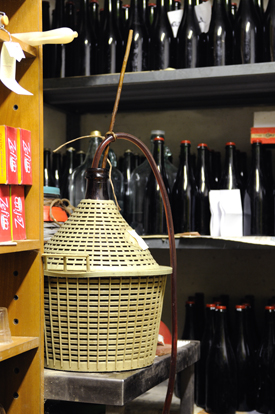
Carlo’s cantina (wine cellar) is a disordered Aladdin’s cave of demijohns, bottles, bottle crates, empty buckets, buckets filled to the brim with maturing fruits, trays of empty tasting glasses, sieves and funnels on a dilapidated rusting garden table, a twisted-spaghetti-like arrangement of various sized tubes and hoses for siphoning, two walls covered top to bottom with a tubular steel shelving unit filled eight bottles deep and twenty-five wide with a year’s supply of wine, a hand-operated crushing press and a lever-arm-operated wine bottling machine. This is where I’ve come to work today.

Carlo’s my next door neighbour. He also runs the neighbourhood bar, La Crocetta. As well as being my neighbour and my barman, he’s also my mentor in all things spiritual, in a manner of speaking. Carlo’s showing me the ropes. In return for lending Carlo a helping hand (and a strong back), he’s been teaching me everything there is to know about making digestivi, amari [bitters] and any other distillations you care to mention.

Carlo makes liqueurs from everything ranging from fruits and berries he collects in the forest and by the roadside, weeds that grow in his garden to herbs he collects from mountain pastures. He makes drinks from herbs so esoteric that no one has been able to tell me their name.

The morning passes as usual. We have to siphon two demijohns, approximately 52 litres, of Bargnolino – a popular local digestive made from sloe berries - into a large basin. We then have to dilute the contents with several liters of wine and then stir in anything up to 10 kilos of sugar, depending on how sweet the mix is. The only way to tell how much sugar to add, naturally, is to taste it!

Carlo dips a ladle into the basin and pours a generous measure into the cup.
“Assaggia [try it]”, he says, looking up and handing me the cup.
“You try it”, I reply, thinking about the pile of pending magazine deadlines, an irate editor (not to mention wife!) and an unwritten blog on my desk.
“Assaggia”, he repeats ignoring me.
Reluctantly I take the cup from his outstretched hand. It’s a deep purple colour, too alcoholic judging by the aroma. Without even trying it I already know he hasn’t added enough sugar yet. But Carlo, of course, knows that too. That’s why he’s asked me down here, to help him correct the problem. Tentatively I take a sip and as I suspected it’s sharp and acidic.
“Amaro [bitter]”, Carlo says, reading my expression. It’s more a statement than a question.  Carlo’s been concocting liqueurs in this basement for so long he can tell what needs doing just by look and smell. Nonetheless, he takes a sip himself, just to confirm.
“Buh”, he says, scrunching up his face in distaste. He makes a vague gesture, which I took to be agreement and so I set to work. More sugar, a kilo at a time along with a bottle of wine. I whisk, mix and stir… and then taste.
Immediately I add each kilo of sugar, Carlo’s handing me another glass.
Finally, many, many glasses later, we arrive at something that is approaching drinkable… and not a moment too soon.
He pours me another measure and one for himself.
“Cin cin” [cheers], he says, downing it in one fierce gulp. One for the road!